
Case Study Three: Restructuring an Underutilized Search Campaign Into a Performance-Driven Growth Channel
Overview
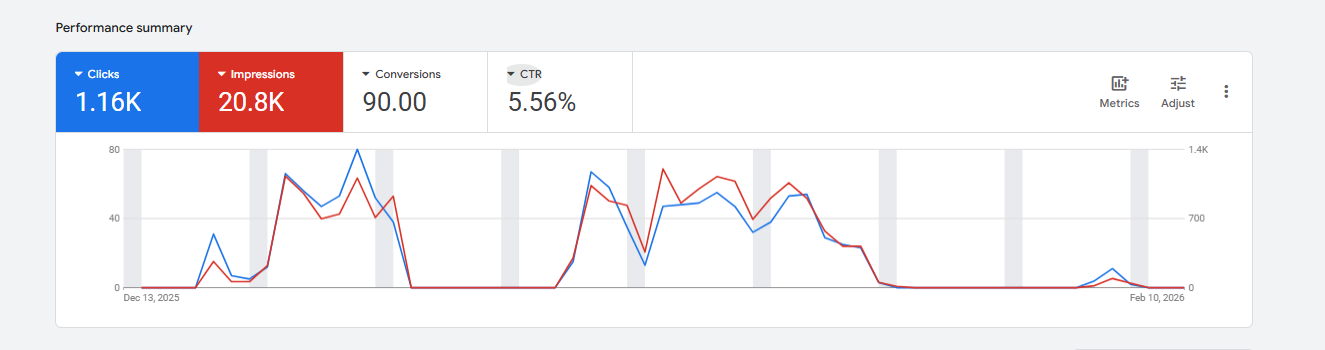
The original paid search campaign was active, but it was not operating at its full potential. On the surface, the campaign appeared stable because it had a strong click-through rate of 5.56%. However, once the campaign was reviewed more closely, the performance story became more complex.
The issue was not that the market lacked demand. The issue was that the campaign structure was too limited to capture that demand at scale. It was generating clicks and conversions, but it was also leaving budget, visibility, and conversion opportunity unused.
Because of that, the campaign needed more than small ad copy edits or keyword adjustments. It needed a strategic restructure that would allow the account to expand delivery, gather stronger conversion signals, and optimize around actual user actions.
The Challenge
The original Search campaign generated:
| Metric | Original Search Campaign |
|---|---|
| Clicks | 1,155 |
| Impressions | 20,758 |
| CTR | 5.56% |
| Cost | $2,660.44 |
| Conversions | 90.00 |
| Cost per Conversion | $29.56 |
| Conversion Rate | 7.79% |
At first glance, the CTR looked good. A 5.56% CTR usually suggests that the ads were relevant to the people seeing them. But this is where a professional review has to go deeper.
A strong CTR does not always mean a campaign is healthy. In this case, the campaign was reaching a smaller audience, producing limited conversion volume, and not using the full available budget. So, while the ads were attracting clicks from the people they reached, the campaign was not reaching enough of the available market.
That matters because paid search should not only be judged by how often someone clicks. It also has to be judged by whether the campaign is capturing enough qualified demand and turning that demand into measurable business outcomes.
The campaign had activity, but it lacked scale.
Why the Original Campaign Was Limited
The original Search structure likely kept the campaign in a narrower delivery environment. That can happen when a campaign is built too tightly around a smaller set of keywords, a restricted audience, conservative bidding, limited delivery settings, or a structure that does not give Google enough conversion data to optimize aggressively.
So, the campaign was not necessarily “bad.” It was just constrained.
That distinction is important.
A poor campaign wastes budget. A constrained campaign leaves opportunity behind. In this case, the data pointed more toward underutilization than total failure. There was enough performance to prove demand existed, but not enough delivery to fully capture it.
That is why the strategy shifted away from simply trying to protect CTR and toward building a structure that could increase qualified reach, conversion volume, and cost efficiency.
Strategic Decision
The campaign was moved from the original Search setup into a Performance Max structure.
This choice was made because the goal was no longer just to capture a narrow group of high-intent search users. The goal was to expand the campaign’s ability to find converting users across a broader performance environment while still optimizing toward measurable actions.
Performance Max gave the campaign more room to work. It allowed the system to use more signals, test more placements, and identify users who were more likely to convert. Instead of keeping the campaign locked into a smaller Search-only structure, the new setup allowed the budget to move toward opportunities that showed stronger conversion potential.
In plain terms, the decision was made because the account needed to stop protecting a surface-level metric and start prioritizing business outcomes.
Why CTR Was Not the Main Success Metric
One of the most important parts of this case study is the CTR decline.
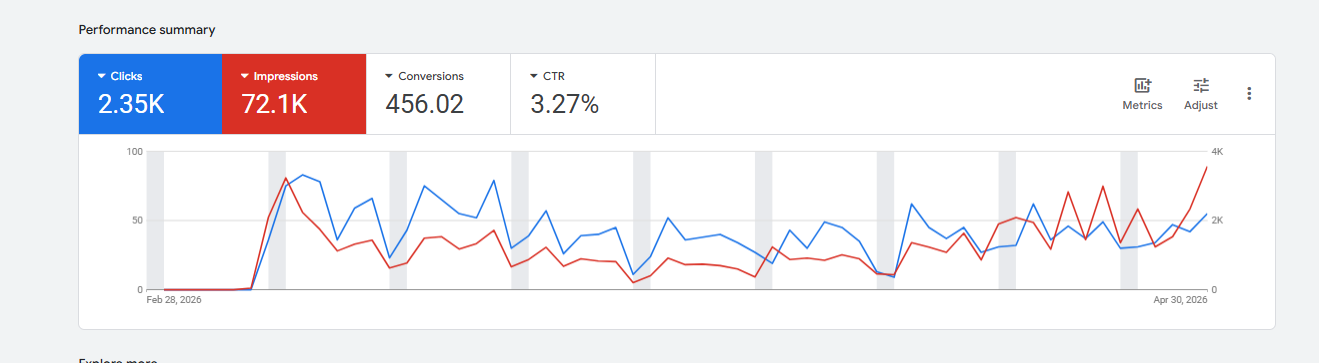
After the restructure, CTR decreased from 5.56% to 3.27%. At a quick glance, that might look like a negative. But in context, it was not the main concern.
The campaign’s impression volume increased from 20,758 to 72,064, which means the campaign expanded into a much larger delivery environment. When a campaign reaches more people and enters more auctions, CTR often drops because the audience pool is broader.
That does not automatically mean the traffic is weaker.
The real question is: What happened after people clicked?
And that is where the restructure proved its value.
Conversion rate increased from 7.79% to 18.34%. So even though the ad was clicked at a lower percentage from the larger impression pool, the users who did click were much more likely to convert.
That is a critical marketing observation. The campaign was not just buying more visibility. It was producing stronger post-click performance.
Results After the Restructure
After the move to Performance Max, the campaign generated:
| Metric | Original Search | Performance Max | Change |
|---|---|---|---|
| Clicks | 1,155 | 2,354 | +103.8% |
| Impressions | 20,758 | 72,064 | +247.2% |
| Cost | $2,660.44 | $5,077.85 | +90.9% |
| Avg. CPC | $2.30 | $2.16 | -6.1% |
| CTR | 5.56% | 3.27% | -41.2% |
| Conversions | 90.00 | 456.02 | +406.7% |
| Cost per Conversion | $29.56 | $11.14 | -62.3% |
| Conversion Rate | 7.79% | 18.34% | +135.4% |
The biggest point here is that spend increased, but performance increased at a much stronger rate.
Cost increased by 90.9%, but conversions increased by 406.7%. That means the additional spend was not simply added into the account. It became productive spend.
At the same time, cost per conversion dropped from $29.56 to $11.14. That is a 62.3% decrease in conversion cost. So the campaign did not only scale. It became more efficient while scaling.
That is the difference between spending more and spending better.
Professional Marketing Interpretation
The original campaign had a higher CTR because it was operating in a smaller, more controlled environment. That made the click rate look stronger, but it also limited reach and conversion volume.
After the restructure, the campaign had more delivery flexibility. It entered a broader environment, reached more users, and gave the system more conversion data to work with. As a result, CTR normalized downward, but the metrics that mattered most improved.
From a marketing perspective, that is a strong tradeoff.
A lower CTR is acceptable when it comes with:
more total clicks,
more conversion volume,
a higher conversion rate,
a lower cost per conversion,
and stronger budget utilization.
That is exactly what happened here.
The new structure showed that the campaign did not need to chase a higher CTR to create stronger business impact. It needed to capture more of the available demand and optimize toward users who were more likely to take action.
Why These Choices Made Sense
The decision to restructure made sense for three main reasons.
First, the campaign was underusing its opportunity. When a campaign is not fully spending or delivering, small optimizations usually do not solve the larger issue. The structure itself has to be evaluated.
Second, the original campaign was too dependent on a narrow performance window. A high CTR can look efficient, but if the campaign is only reaching a small portion of the market, it can still limit growth.
Third, the business needed more conversion volume at a sustainable cost. The Performance Max structure allowed the campaign to expand while still optimizing toward conversion actions. That made it a better fit for growth than a limited Search-only setup.
The results support that decision. The campaign became broader, but it also became more efficient.
Case Study Takeaway
This case study shows why paid media performance should not be judged by CTR alone.
The original Search campaign looked stronger on the surface because the CTR was higher. But once the full performance picture was reviewed, the campaign was clearly limited. It had lower reach, fewer clicks, fewer conversions, and a much higher cost per conversion.
After the campaign shifted into a Performance Max structure, visibility expanded, traffic increased, conversion volume grew, and cost per conversion dropped significantly. The lower CTR reflected expanded delivery, not weaker performance.
The most important takeaway is this:
The campaign moved from limited activity to scalable performance. It stopped protecting a narrow CTR and started producing stronger business outcomes.