
Case Study One: Improving Search Visibility Through Website Structure
Case Study Overview
This case study examines the evolution of a multi-location healthcare search ecosystem that moved from unstable visibility, inconsistent regional performance, and branded search dependency into a more stable and interpretable SEO environment.
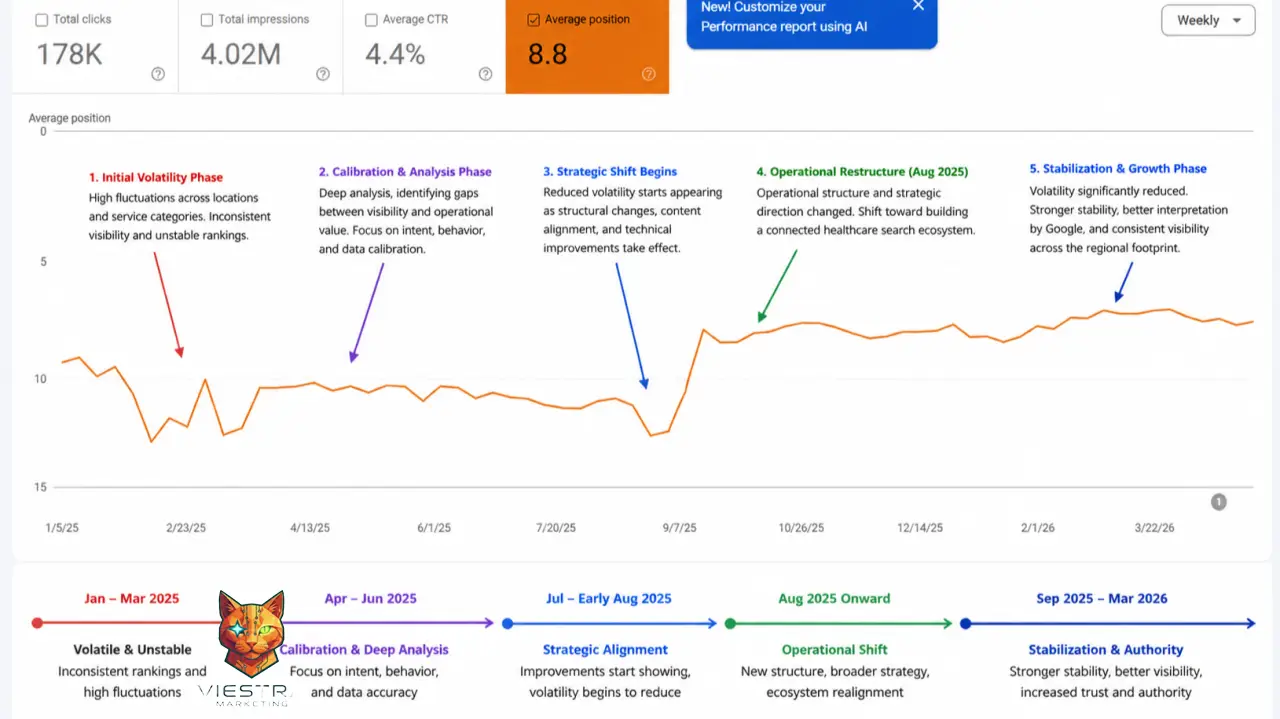
The work began in March 2025 with analysis, calibration, and performance review. By August 2025, the strategic direction shifted more significantly toward operational restructuring, non-branded intent expansion, and long-term search ecosystem alignment.
The main objective was not simply to increase traffic or chase rankings. The objective was to understand why visibility existed in some areas, why it was unstable in others, and how to build a system Google could repeatedly interpret, validate, and trust across a regional healthcare footprint.
The most important outcome was not just growth.
It was the reduction in volatility.
That reduction showed that the search ecosystem was becoming more structurally consistent, better aligned with real healthcare intent, and less dependent on isolated ranking movement.
1. Business Context
The organization operated in a competitive, multi-location healthcare environment within one state. The search landscape included competition from local providers, hospital systems, national urgent care brands, healthcare directories, map-pack results, and broad informational healthcare sites.
This meant the SEO strategy could not rely only on traditional keyword optimization.
The environment needed to support:
local healthcare discovery
non-branded urgent care intent
occupational health intent
regional service relevance
location-level authority
patient behavior analysis
technical clarity
operational performance alignment
Because the organization already had search visibility, the challenge was not starting from zero.
The challenge was understanding the quality, stability, and operational meaning of that visibility.
2. Initial SEO Environment
When the work started in March 2025, the search environment showed visible activity but lacked consistency.
At a surface level, the organization had:
organic impressions
clicks
rankings
conversions
location visibility
and branded search demand
However, once deeper analysis began, several issues became clear.
Key Issues Identified
Volatility Across Locations
Ranking behavior changed heavily across regions and service categories. Some locations performed well while others struggled outside of branded demand.
This created inconsistent search visibility across the footprint.
Fragmented Search Interpretation
Google could identify parts of the organization, but the relationships between locations, services, local intent, and operational relevance were not always clear.
This reduced the consistency of how the site was interpreted across broader non-branded healthcare searches.
Branded Dependency
Branded search demand created a level of performance stability, but that stability did not fully represent non-branded authority.
This mattered because branded visibility can make a healthcare organization appear stronger than it is across discovery-based search behavior.
Reporting Misalignment
Traffic, clicks, and conversions were being reviewed as performance indicators, but they were not always calibrated against real operational behavior.
In healthcare, a click does not always represent patient intent.
A conversion does not always represent true acquisition.
And traffic does not always represent growth.
3. Strategic Problem
The main problem was not lack of visibility.
The main problem was lack of interpretational consistency.
The search ecosystem needed to answer several questions:
Which visibility was driven by branded demand?
Which visibility reflected broader healthcare discovery behavior?
Which conversions represented meaningful patient action?
Which locations had true non-branded strength?
Which pages were ranking because of authority, and which were ranking because of navigational demand?
Where was volatility coming from?
Did digital performance align with operational behavior?
This shifted the strategy away from basic SEO reporting and into a more advanced analysis of search behavior, operational alignment, and system trust.
4. Strategy Framework
The strategy was built around one primary concept:
Calibration
Calibration meant connecting digital performance to real-world healthcare behavior.
Instead of evaluating SEO through rankings and clicks alone, the analysis focused on how search behavior translated into operationally meaningful signals.
The framework included:
Search Behavior Analysis
Understanding how users moved from search visibility into website engagement, scheduling behavior, directional intent, and service exploration.
Intent Segmentation
Separating branded demand from non-branded healthcare discovery behavior.
This helped identify whether visibility was coming from users who already knew the organization or from users searching for care options.
Location-Level Evaluation
Reviewing how different regions behaved separately rather than assuming the full organization performed uniformly.
Service-Level Evaluation
Looking at how service categories such as urgent care, walk-in treatment, occupational health, DOT physicals, and local healthcare modifiers contributed to search visibility.
Operational Alignment
Reviewing whether digital signals supported actual healthcare acquisition behavior instead of only marketing activity.
Technical and Structural Review
Evaluating whether the site structure, schema, internal relationships, and location/service alignment helped Google understand the ecosystem clearly.
5. Phase One: March 2025 Through Early Summer
The first phase focused on diagnosis, volatility review, and calibration.
This phase was not about making fast assumptions.
It was about understanding where the search ecosystem was unstable and why.
Focus Areas
Performance Quality Over Performance Volume
The goal was not simply to increase numbers. The goal was to determine which numbers actually mattered.
This meant reviewing:
engagement quality
scheduling behavior
directional behavior
query intent
location performance
conversion quality
and the relationship between reported performance and operational value
Visibility Versus Authority
A major distinction emerged between visibility and authority.
A site can appear in search results without being strongly trusted across competitive non-branded queries.
This distinction became important because branded visibility was helping the environment look more stable than it really was.
Volatility Mapping
Ranking volatility was reviewed across time, regions, and service categories.
The goal was to identify where Google’s interpretation appeared inconsistent.
Volatility was treated as a signal, not just a problem.
It indicated where the ecosystem needed stronger structure, clearer intent, and better alignment.
6. Phase Two: Mid-Summer Through August 2025
By mid-summer, the strategy started moving from analysis into stronger alignment.
The ecosystem began shifting away from isolated campaign thinking and toward connected search architecture.
Around August 2025, the operational structure and strategic direction changed more significantly.
This became a turning point.
Strategic Shift
The strategy moved away from simply managing visibility and toward building interpretational stability.
This meant strengthening how Google understood:
what the organization did
which services were connected to which location
show users searched for care
which pages supported which intent group
show local relevance connected across regions
and how non-branded healthcare discovery should map to the site
The goal was not only to rank.
The goal was to reduce ambiguity.
7. Non-Branded Intent Expansion
One of the most important strategic shifts was reducing dependency on branded search stability.
Branded search behavior often produces stronger surface-level metrics because users already know what they are looking for.
Branded searches commonly create:
higher CTR
stronger engagement
cleaner conversion paths
dominant rankings
and lower friction
However, branded strength does not automatically prove broader healthcare authority.
For a healthcare organization to build stronger regional authority, it needs to compete across non-branded discovery behavior.
The strategy expanded around intent areas such as:
urgent care searches
walk-in care searches
occupational health searches
DOT physical searches
service-based healthcare searches
regional healthcare modifiers
local urgent care relevance
and broader care discovery behavior
This was a more competitive environment because Google had to compare the organization against hospitals, urgent care chains, local providers, directories, and map results.
That made stability harder to achieve.
It also made stability more meaningful once it started appearing.
8. Technical and Structural Alignment
Technical SEO was not treated as isolated cleanup.
It was treated as part of the broader interpretation system.
The technical work supported the larger strategic goal of helping Google understand the relationship between services, locations, and healthcare intent.
Key Structural Priorities
- Location Relationship Clarity
- Location pages and regional signals needed to communicate clear local relevance.
- Service Relationship Clarity
- Service categories needed stronger connection to search intent and patient behavior.
- Schema Alignment
Structured data helped reinforce what the organization was, what services it offered, and how those services connected to local healthcare intent.
Internal Consistency
The search ecosystem needed consistent relationships between content, navigation, services, locations, and user pathways.
Behavioral Clarity
Users needed clearer pathways from search intent into meaningful action, such as scheduling, calling, getting directions, or exploring relevant services.
9. Measuring the Shift
The most important performance pattern was not a single ranking spike.
It was the reduction of instability over time.
The ranking trend showed an earlier period of volatility, followed by a stronger and more stable average position range after the strategic shift.
At the broader performance level, the environment showed:
significant organic impressions
meaningful organic click volume
a competitive average position
healthy CTR for a healthcare search environment
and improved ranking stability after the operational shift
Because the organization operated within a single state, the scale of visibility suggested strong regional search penetration rather than broad national reach.
That distinction matters.
For a single-state healthcare organization, broad visibility across millions of search appearances indicates that Google was surfacing the site across more than simple branded demand.
The combination of impression volume, CTR behavior, and average position suggested that the site was being evaluated across more competitive discovery-based healthcare queries.
10. Why Volatility Reduction Mattered
In SEO, especially healthcare SEO, temporary ranking increases can happen for many reasons.
They can come from seasonality, algorithm testing, content freshness, branded demand, or short-term query shifts.
But stability is different.
Stable visibility suggests that Google is becoming more confident in how it interprets the site.
In this case, the reduction in volatility suggested stronger alignment between:
search intent
entity understanding
location relevance
service relevance
technical structure
behavioral quality
operational value
and regional trust
That is why the reduction in volatility became one of the strongest signals in the case study.
It showed that the environment was becoming more interpretable.
And in healthcare SEO, interpretability is a major part of long-term trust.
11. Results and Strategic Impact
The strategic impact can be summarized in four areas.
1. Stronger Search Interpretation
The ecosystem became easier for Google to understand across services, locations, and regional healthcare intent.
2. Reduced Volatility
Ranking behavior became more stable after the strategic and operational shift.
This indicated stronger system consistency.
3. Broader Non-Branded Relevance
The strategy moved beyond branded search dependency and strengthened alignment with discovery-based healthcare intent.
4. Better Operational Alignment
Performance review became more calibrated to real healthcare behavior rather than surface-level activity metrics.
12. High-Level Takeaways
Visibility Is Not the Same as Authority
A healthcare organization can have visibility without having stable authority across competitive non-branded searches.
Branded Search Can Hide Weaknesses
Branded demand can inflate confidence because it often produces strong CTR, engagement, and conversion behavior.
Calibration Is Required in Healthcare SEO
Healthcare SEO needs to connect search data to operational behavior. Otherwise, reporting can overstate performance quality.
Volatility Is a Diagnostic Signal
Volatility can reveal where Google is struggling to consistently interpret a site’s services, locations, or authority.
Stability Is a Trust Signal
In healthcare SEO, stable visibility often matters more than short-term ranking movement because it suggests stronger interpretational confidence.
SEO Is Now a Systems Discipline
Modern SEO is no longer just about keywords, title tags, and rankings.
It is about building connected systems that align:
technical SEO
local relevance
search intent
user behavior
entity understanding
and operational value
13. Final Analysis
This case study shows how a multi-location healthcare SEO environment can evolve when the strategy moves beyond traffic and rankings.
.
The strongest improvements came from understanding the system underneath the data.
The work required separating visibility from authority, activity from acquisition, and branded stability from true non-branded search strength.
The turning point came when the strategy shifted toward calibration, operational alignment, and interpretational consistency.
Over time, volatility decreased.
Search visibility became more stable.
The ecosystem became clearer.
And the organization moved closer to what strong healthcare SEO should become: a connected, trusted, regional search system that Google can repeatedly understand, validate, and serve for relevant healthcare intent.
That is where volatility turns into stability.
And where visibility starts becoming authority.