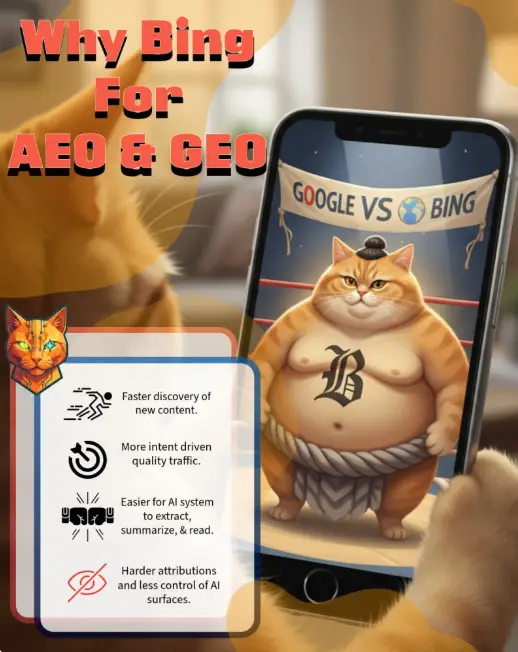
I’ve been thinking a lot about why “AI visibility” starts to feel real the moment your pages become easier for Bing to discover and understand. While rankings still matter, I’m seeing that retrieval matters too, because AI experiences can only reference what they can find, crawl, and interpret. That’s why I treat Bing searchability like a foundation step, not an optional extra. First, I speed up discovery with IndexNow so Bing receives a clear signal when I publish or update a page. Next, I keep crawling clean with an updated XML sitemap and freshness signals like lastmod, because outdated signals can quietly slow momentum. Then, I add structured data with Schema.org so machines can interpret exactly what a page is about, which also reduces the chance of my content being summarized incorrectly.
Finally, I validate everything inside Bing Webmaster Tools by checking for crawl or indexing blockers and using URL Inspection to confirm the page is actually eligible to show.
Faster discovery is the real advantage when I publish
One reason I keep leaning into Bing for AI visibility is that faster discovery changes everything when I’m publishing new content. If Bing finds my updates quickly, then my pages become eligible for retrieval sooner, and that matters because AI-style search experiences tend to reward what’s current, clear, and available right now. So when I publish a new service page, a tool page, or a fresh update to an existing page, I want it discovered fast enough to compete while the topic is still active. That’s why I treat speed of indexing as a performance lever, not a technical detail.
Why the traffic feels different.
Another thing I’ve noticed is that the traffic that comes through these discovery paths often feels more intent-driven. When someone finds my content through search or through an AI-assisted path, they usually show up with a specific question, a comparison they’re trying to make, or a decision they’re trying to finalize. Because of that, the visit quality can be different than the casual scroll traffic I might get from social alone. In practice, I see more problem-aware users, more direct service interest, and more “I need this solved” behavior, which is exactly the type of traffic I want when my goal is leads or conversions.
Why structure matters even more in AI search.
This is also why I focus so much on structure and machine clarity. AI does not read like a human. It looks for patterns, meaning, and extractable sections it can summarize without breaking accuracy. So when I use headings that match real questions, keep sections tight, include definitions, add examples, and support everything with structured data, I make the content easier for AI to extract, summarize, and reuse correctly. That’s the difference between content that gets retrieved and content that gets ignored. Even more importantly, it reduces the chance that my message gets warped when it gets summarized.
Now I want to build on that last part, because this is where most visibility issues actually live. I’ve learned that a lot of “AI discoverability” problems are not caused by content quality at all. They are caused by simple blockers that quietly prevent a page from being crawled or indexed in the first place. So after I do the big four steps, I always run one extra check that keeps me from wasting time. I check robots.txt and I check the meta robots tags on the page, because either one can accidentally tell Bing not to index something important. Then I use URL Inspection to confirm Bing can actually crawl and index the page, and I also use it to spot markup or SEO issues that might be limiting how clearly the page is being interpreted.
The part most people miss, and why I confirm it every time.
This is the part many people miss, so I want to spell it out in a way that makes it easier to apply. When I say “robots.txt,” I’m talking about the file that can block entire sections of a site from being crawled. It can be helpful when it’s intentional, yet it can also quietly destroy visibility when it’s overly restrictive or outdated. Then, when I say “meta robots tags,” I’m talking about instructions on the page itself, like noindex or nofollow. Those tags are powerful, because even if the page looks perfect to a human, one wrong setting can still tell a search engine not to index it. That’s why I don’t rely on assumptions. I confirm eligibility. I want proof that Bing can crawl the page, and I want proof that it is actually indexable.
From there, URL Inspection becomes my reality check. It tells me whether Bing can access the page, and it also helps me catch issues that don’t always show up in a quick scan. Sometimes the problem is a technical blocker. Other times the problem is that the page is technically indexable but still hard for machines to interpret. That’s where markup and structure come back into play. If the content is unclear, the page can still underperform, even if it is indexed. So I treat this like a chain. If one link breaks, the whole thing breaks.
Bing and Google together, not Bing versus Google.
Now here is the part that ties Bing and Google together, because I don’t see this as an either-or decision. Google still drives massive demand, and it still matters for scale and for capturing the biggest volume of searches. At the same time, I’m watching Bing become increasingly important in the AI layer, because AI experiences need a reliable discovery and indexing system to pull from. So when I strengthen Bing visibility, I’m not trying to replace Google. I’m building a second door into the same house, and that door often connects more directly to AI-style discovery. When I build for both, I stop relying on one pathway for visibility, and I give my content multiple ways to be found, understood, and repeated.
This is important because AI search is not the same as traditional search. Traditional search is often a ranking and click behavior. AI search is often a retrieval and summarization behavior. So the question shifts. Instead of only asking, “Can I rank,” I’m also asking, “Can I be retrieved, quoted, and reused accurately?” That’s where Bing’s functionality keeps standing out to me. IndexNow gives me a way to communicate updates quickly. Bing Webmaster Tools gives me a way to validate what is happening. Then structured data gives me a way to reduce ambiguity, because machines do better when the page clearly defines who it is about, what it offers, and how it connects to related topics.
This matters because more people are getting answers through conversational tools, and those tools still need a way to find pages, confirm they exist, and understand what they mean. When Bing picks up my pages faster, reads them more cleanly, and validates them more clearly, my content becomes easier to retrieve, and that often shows up as more mentions, more citations, and more indirect exposure even before I see a click. Even when a click does not happen immediately, being repeatedly referenced builds familiarity. Then later, when someone is ready to act, they search the brand name, they remember the framework, or they reach out directly. That is a different path than classic SEO, but it still produces real outcomes.
The tradeoff I plan for, because attribution is harder now.
At the same time, I also want to be honest about the tradeoff, because attribution gets harder in this world. A lot of AI discovery happens without a clean click path. Sometimes the user gets an answer directly inside the experience, and sometimes they search my brand later instead of clicking in the moment. That means the influence can show up as indirect exposure, branded searches, or “I saw this somewhere” leads that don’t map neatly to last-click reporting. So I don’t treat AI visibility as a pure traffic play. I treat it as an awareness and trust layer that can still drive revenue, but it often requires better measurement habits, better UTM discipline, and more patience when I’m evaluating results.
What I like about this approach is that it turns visibility into something I can verify instead of something I have to guess. If the page is blocked, I know exactly why. If it is crawlable but not indexed, I can work backwards and fix the signal problems. If it is indexed but performing inconsistently, I can look at structure, internal linking, or page clarity instead of blaming “the algorithm.” That creates a cleaner path to improvement, and it also makes the results easier to explain to a client or a team. It turns the conversation from opinions into diagnostics, and that is where real progress happens.
Why I tie this directly into social.
Now I want to connect this to the social side too, because visibility is not only about being indexed. It is also about being repeated. So when I post, I reuse the same principle of validation. I make one clear point, I support it with a quick reason, and then I give an action someone can do right away. I write in clear sections, I answer specific questions directly, and I keep my language consistent with the entities I want associated with my brand. I also avoid vague statements that can be interpreted five different ways, because vague content gets skipped, while specific content gets saved.
Then I take it one step further. I design my posts so someone can learn without needing to DM me. I define terms briefly, I give context, and I provide a simple checklist. For example, instead of saying “fix indexing,” I explain what I actually check. I confirm the page is not blocked by robots.txt. I confirm the page does not contain a noindex directive. I confirm Bing can crawl it using URL Inspection. Then I look for markup or clarity issues that might affect how the page gets interpreted and summarized. That way, someone reading the post can take immediate action, and the post becomes useful instead of just informational.
As a result, my posts become easier to scan, easier to quote, and easier to turn into the next step someone needs. Over time, that creates a loop. The site becomes more machine-readable, and social becomes more human-readable, while both stay consistent in how they describe the topic. That consistency is what helps the message travel.